
Reviewed · PALERMO CITY TOURS
Discover Palermo in 3 hours. Art, history, markets and street food
Three hours is enough for real Palermo. You get art and history on foot, plus markets and street food, all guided by a Palermo native in Italian.
I especially like the way the route ties together different Palermo eras, from Norman-Arab masterpieces to baroque street corners. I also like that you’ll stop at Capo Market and get free tastings, so it’s not just monuments and photos.
One big consideration: the tour is ONLY IN ITALIAN, so if you’re not comfortable following Italian conversation, you may struggle to get the most out of the stories.
In This Review
- Key highlights to look for
- A 3-hour sprint through Palermo’s historic center
- Capo Street Market: Arab origins and street-food momentum
- Palermo Cathedral: Norman-Arab art, Santa Rosalia, and royal tombs
- Piazza Giuseppe Verdi and Teatro Massimo: Belle Epoque power in stone
- Quattro Canti: the baroque square where the old city “clicks”
- Piazza Pretoria and the Fountain of Shame: 48 statues, one nickname
- Piazza Olivella: church views plus an archaeology boost
- Piazza Bellini: churches packed with styles and centuries
- Teatro dell’Opera dei Pupi: Palermo’s puppet theater culture
- The Cassaro, Porta Carini, and the walls that guard the market area
- What you get for $34.76: value, pacing, and real decisions
- Logistics that matter: language, timing, and where the walk starts
- Who should book this Palermo walking tour
- Should you book this 3-hour Palermo art-and-food walk?
- FAQ
- Is the tour only offered in Italian?
- How long is the walking tour in Palermo?
- Where do I meet the guide and where does the tour end?
- What’s included at Capo Street Market?
- Is Palermo Cathedral included in the price?
- What group size should I expect?
- Can I cancel for a full refund?
Key highlights to look for
- Capo Market entry plus free tastings in a real everyday neighborhood food scene
- Palermo Cathedral included, with Norman-Arab art and key royal and religious highlights
- Teatro Massimo in Piazza Giuseppe Verdi, tied to Belle Epoque and the Florio family
- Quattro Canti and Baroque squares, where Palermo’s old-city geometry shows off
- Fontana Pretoria, the Fountain of Shame, with 48 Carrara statues and a local nickname
- Piazza Bellini and historic churches, including Martorana and Arab-style San Cataldo
The rest of what Palermo puts on
- Palermo: NO Mafia Walking Tour
★ 4.8 · 2,431 reviews - Palermo: Hop-on Hop-off Bus Tour 24-hour Ticket
★ 3.9 · 2,410 reviews - Palermo Original Street Food Walking Tour by Streaty
★ 5.0 · 2,105 reviews - Segesta, Erice and Salt Pans Full-Day Excursion from Palermo
★ 4.2 · 1,791 reviews
A 3-hour sprint through Palermo’s historic center
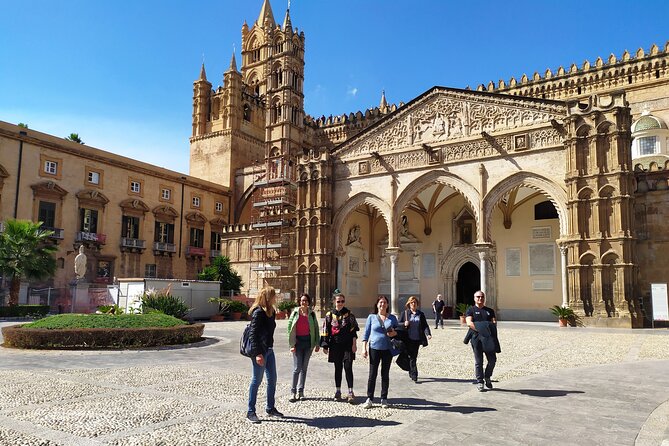
This is the kind of tour you book when you have limited time, but still want more than a checklist. You start at Via Cavour and finish at Piazza Bellini, walking through the historic core in roughly three hours. The pacing is built for “see it, understand it, then wander smart” rather than rushing.
The value is in the storytelling. You’re not just passing buildings. You’re learning what to notice: why a cathedral looks the way it does, what a square is doing at street level, and why certain local legends and events keep popping up around Palermo’s landmarks.
Group size is capped at a maximum of 16, which helps you hear your guide and still move at a walking pace that works for most people. It’s also listed as a good option for cruise passengers, thanks to the short distance from the port area and the fact that you get practical info.
Capo Street Market: Arab origins and street-food momentum
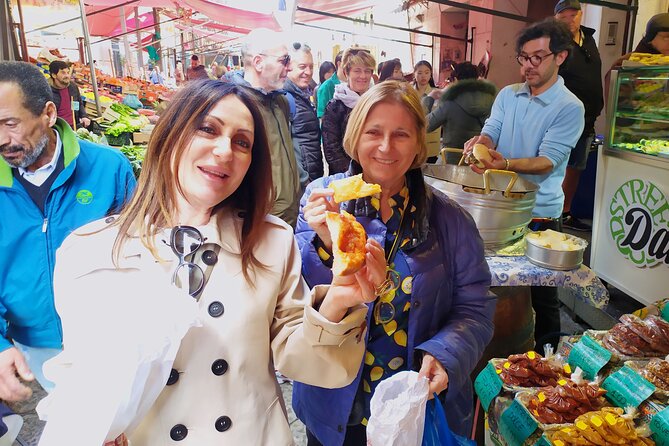
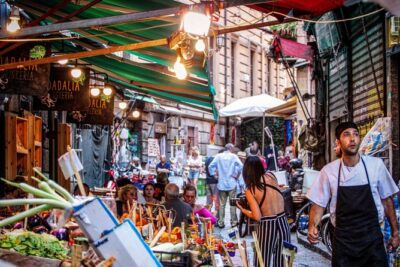
Your walk begins at Capo Street Market along Via Porta Carini and Via Bandiera. This isn’t a souvenir-market imitation. It’s an ancient food market described as having Arab origins, and it runs daily in this same corridor of streets.
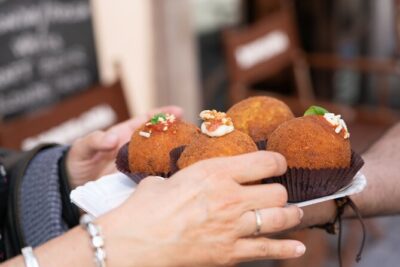
You get admission included for the market stop, and the tour includes free tastings of food and drinks. That matters because it turns the market into more than a backdrop. You get to sample while you’re learning what you’re looking at.
Practical note: markets mean smells, noise, and lots of movement. That’s the point. Bring a realistic expectation: you’re stepping into daily life. If you’re picky about crowds or you hate lingering in narrow lanes, you might treat the tastings like quick bites and keep your eyes on your guide so you don’t lose the thread.
Palermo Cathedral: Norman-Arab art, Santa Rosalia, and royal tombs
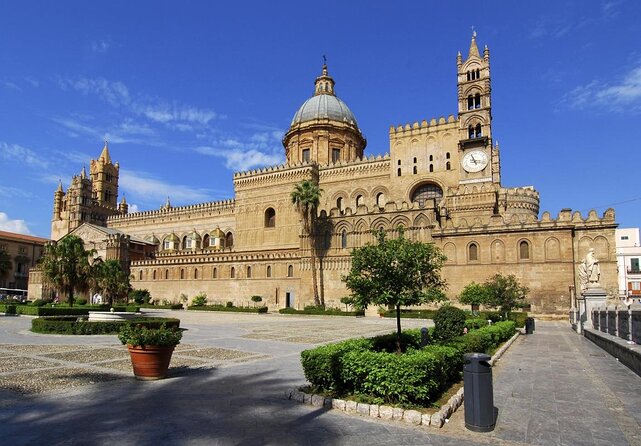
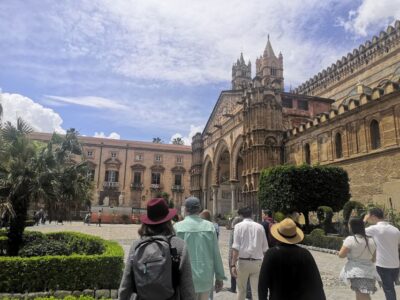
Next up is the Cattedrale di Palermo (Palermo Cathedral). This is a centerpiece stop, and the details given are the kind that make a visit feel personal instead of generic. The cathedral is a Norman Arab masterpiece built in 1185 and tied into the UNESCO Arab-Norman itinerary.
Even better: cathedral entry is included at no extra cost in the tour price. So you’re not hunting for tickets or scrambling to get in.
What you’ll want to look for during your time there:
- Royal tombs, which connect the cathedral to the power of rulers and dynasties
- The chapel of Santa Rosalia, the religious heart of Palermo’s identity
- An extraordinary sundial, a detail that can easily be missed if you’re only looking for the big church façade
Time on-site is listed at about 25 minutes. That’s enough for a focused walk-through if you’re following the guide’s path. If you’re the type who likes to read every panel and keep stopping for photos, you may wish you had more minutes. Still, this stop is worth it because the cathedral is the tour’s anchor: it sets the tone for everything you see next.
Piazza Giuseppe Verdi and Teatro Massimo: Belle Epoque power in stone
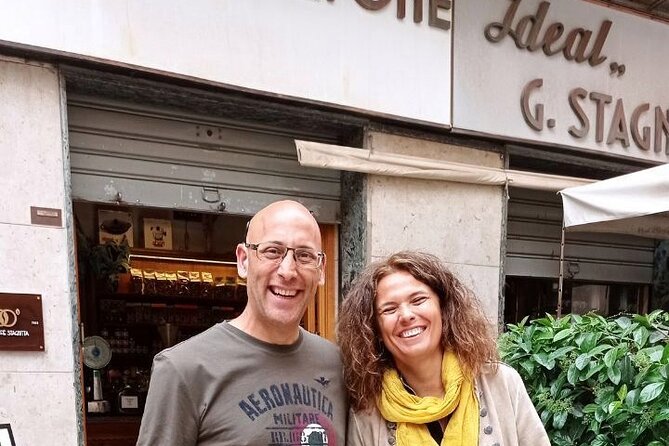
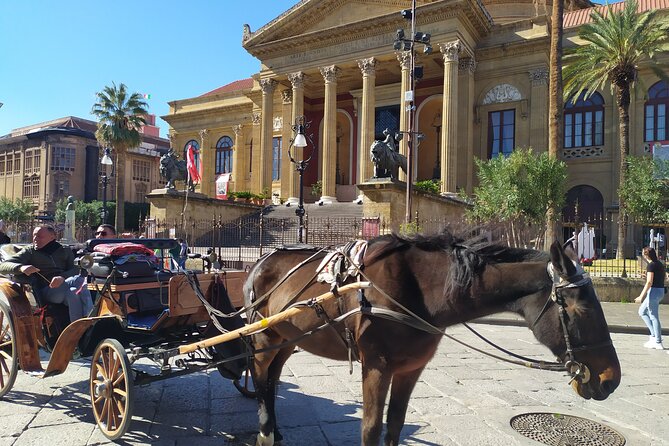
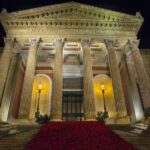
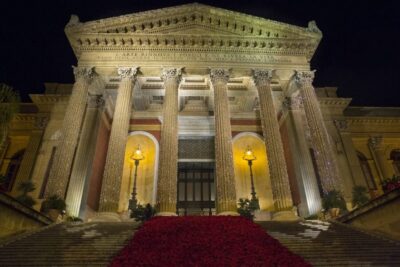
After the cathedral, the route heads to Piazza Giuseppe Verdi (Piazza Massimo). This is where you meet Teatro Massimo, described as the largest theater in Italy and a major symbol of Palermo’s Belle Epoque era and the Florio family.
From street level, the theater’s scale can be hard to judge until you’re standing there. That’s one reason a guided stop helps: the guide gives you context for why the building is framed this way, and why the Florio story is linked to what Palermo wanted to show the world.
You’ll get about 15 minutes here, so treat it like an “observe first, ask questions second” stop. If you’re interested in opera, this is also where you’ll start noticing how Palermo mixes performance, politics, and public identity.
More street-food crawls around Palermo
Quattro Canti: the baroque square where the old city “clicks”
Then comes Quattro Canti, often called a scenographic baroque square at the center of Palermo’s ancient city. This is one of those places where the architecture explains the city plan. It’s a crossroads moment, and your eyes will naturally start mapping streets like you’re doing the city on easy mode.
The tour gives about 10 minutes at Quattro Canti, and that’s enough time to take in the symmetry and understand what you’re seeing. If you want extra time for photos, quick—because the walk keeps moving.
Drawback to consider: with a short stop and a small group, it can feel like a “look and go” moment. If you love sitting and people-watching, you’ll likely want to return later on your own.
Piazza Pretoria and the Fountain of Shame: 48 statues, one nickname
Piazza Pretoria is another signature stop, and it’s the one that can get the biggest reaction because it has a built-in story. The Fontana Pretoria is considered one of Palermo’s most beautiful fountains, made up of 48 statues of white Carrara marble sculpted in the middle of the Renaissance by Tuscan sculptors.
Here’s the detail that makes it memorable: it was purchased in 1573, and Palermitans nicknamed it the Fontana della Vergogna, translated in the tour materials as the Fountain of Shame.
That nickname alone tells you the fountain’s story isn’t just about art. It’s also about local attitudes and how public space can mean more than beauty. When your guide shares the backstory, you start seeing the fountain as a social clue, not just a postcard.
You get about 10 minutes here. That’s perfect for photos and a quick “okay, now I get it” moment.
Piazza Olivella: church views plus an archaeology boost
From Piazza Pretoria, you’ll walk to Piazza Olivella, described as scenic and anchored by the Baroque church of Sant’Ignazio and the nearby Archaeological Museum (noted as one of the most important in Italy).
You’ll have about 20 minutes at this stop, which gives you room to look around and absorb the square’s energy without feeling rushed. Since museum entrances are not listed as included, your time here is more about external context—seeing where culture lives and how the city organizes its “layers.”
If you’re the type who loves archaeology, you might use this stop as a reason to plan a longer museum visit later during your trip.
Piazza Bellini: churches packed with styles and centuries
Next is Piazza Bellini, one of the most historic-feeling squares on the route. The area is overlooked by major churches that show Palermo’s mixing of influences over time.
This stop is listed at 10 minutes, so you’ll want to keep your eyes on the guide’s highlights. Key buildings mentioned include:
- Church of the Martorana (12th century)
- San Cataldo, an Arab-style church
- Church and Monastery of Santa Caterina
You’ll also finish the tour at Piazza Bellini (the end point is listed there). So this square is both a highlight and a “now you can roam” send-off.
If you like walking tours that teach you what to look for when you’re on your own afterward, this is a great finish point. It’s central, full of visual clues, and easy to build a plan around.
Teatro dell’Opera dei Pupi: Palermo’s puppet theater culture
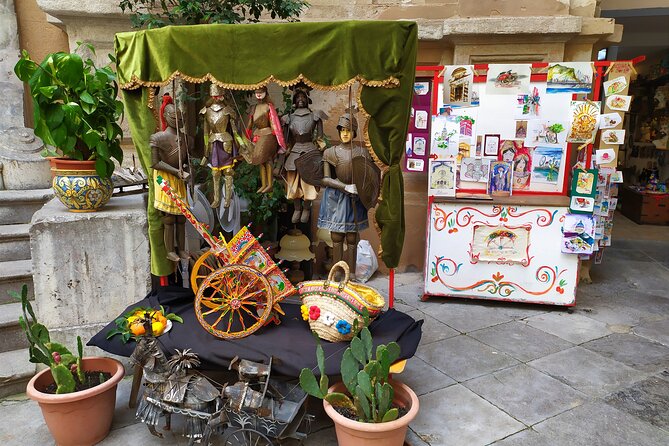
Before you reach the final leg, the route includes Teatro dell’Opera dei Pupi. This is connected to a traditional Palermo show dating back to the 1800s, with mention of Mimmo Cuticchio.
It’s also noted as UNESCO Heritage, which helps you understand why this isn’t just quirky entertainment. It’s a living tradition that carries local storytelling skills and visual style.
The stop is short—about 10 minutes—and this tour is focused on walking and seeing the urban story, not sitting through a full performance. Still, it’s a worthwhile cultural checkpoint because it adds a different kind of history than stone monuments alone.
The Cassaro, Porta Carini, and the walls that guard the market area
One of the best ways to understand Palermo is to learn its “main spine.” The tour mentions the ancient Cassaro, the oldest street in Palermo, lined with palaces, churches, and convents.
Then you get one of the route’s most practical links: Mura, Bastione e Porta Carini. These are ancient walls from the first half of the 16th century, leading to Porta Carini, which is the entrance through which you move into the Capo market area.
This part ties everything together: monuments at one end, and daily food culture at the other. You stop to recognize the walls not just as scenery, but as the structure that helped shape where people moved and where commerce gathered.
Total time for the walls and Porta Carini is about 15 minutes. That’s enough to notice the scale and understand why the market feels like it’s been there forever—because it has, at least in the sense of place and urban continuity.
What you get for $34.76: value, pacing, and real decisions
At $34.76 per person for roughly three hours, this tour is priced like a smart time-saver, not like a long sit-down cultural program. The key value: you’re paying for guided interpretation plus a couple of meaningful inclusions.
Here’s what’s included based on the tour details:
- Entrance to Capo Market
- Free tastings of food and drinks at included stops
- Palermo Cathedral entrance (included in price)
- Guide in Italian
- A “where to eat” style promise for best cannoli and coffee recommendations (the tour says the guide will reveal where to get them)
What’s not included: food and drinks beyond the free tastings, plus any museum or palace tickets (no museum entrances are listed as included).
So, how do you decide if it’s worth it? I’d say this tour earns its money if you’re:
- Short on time and want a first-orientation walk through the center
- Interested in how Palermo mixes Norman-Arab themes with baroque urban design
- Motivated to learn a bit of context before you eat, not after you’ve already ordered
If you’re already fluent in Italian city history or you only want architecture with no stories, you might feel the tour is too “talk-heavy.” But the feedback highlights in the course description point to energetic guides like Maurizio and Fabrizio who keep people engaged for the full 2–3 hours. (Your exact guide depends on the day.)
Logistics that matter: language, timing, and where the walk starts
Timing is 10:30 am. The meeting point is Via Cavour, 135, 90139 Palermo PA, Italy, and the walk ends at Piazza Bellini, 90133 Palermo PA, Italy.
It’s also described as using a mobile ticket, and it’s near public transportation. Service animals are allowed.
Language is the real deciding factor. Because it’s Italian-only, I’d treat it as a language-and-culture activity too, not only a sightseeing one. If you can follow basic Italian or you’re motivated to practice, you’ll likely find the tour much more satisfying.
Who should book this Palermo walking tour
Book it if:
- You want a tight route through major landmarks without choosing each one yourself
- You like story-first sightseeing, where legends and local explanations change how you see the buildings
- You want a mix of art, churches, street life, and food in a single morning-style session
Consider skipping or pairing it with another plan if:
- You’re not comfortable with Italian, since the tour is only in Italian
- You want long museum time, since this is built for walking stops and quick on-site viewing
Should you book this 3-hour Palermo art-and-food walk?
I’d recommend it as a smart first Palermo move, especially if you’re staying for a short time or coming from a cruise. The route focuses on high-impact stops: Capo Market, Palermo Cathedral, baroque squares like Quattro Canti, and the striking Fontana Pretoria with its dramatic nickname.
The only real catch is language. If you can follow Italian, this tour gives you both orientation and local flavor fast. If you can’t, the structure is still beautiful, but you may miss the stories that make it feel like Palermo instead of just architecture.
FAQ
Is the tour only offered in Italian?
Yes. This experience is listed as ONLY IN ITALIAN, with an Italian guide.
How long is the walking tour in Palermo?
The duration is approximately 3 hours.
Where do I meet the guide and where does the tour end?
The meeting point is Via Cavour, 135, 90139 Palermo PA, Italy. The tour ends at Piazza Bellini, 90133 Palermo PA, Italy.
What’s included at Capo Street Market?
You get entrance to Capo Market and free tastings of food and drinks during the experience.
Is Palermo Cathedral included in the price?
Yes. Entrance to the Cathedral of Palermo is included (and is free as part of the tour).
What group size should I expect?
The tour has a maximum group size of 16 travelers.
Can I cancel for a full refund?
Yes. There is free cancellation. You can cancel up to 24 hours in advance for a full refund.
More Tour Reviews in Palermo
More Sicilian Street-Food Crawls

More Palermo, Start to Finish
Just added: the newest Palermo tours in our notebook
- Private Transfer from/to Trapani★ 5.0 · 3 reviews
- Private Tour from Palermo to Monreale, Santa Rosalia and Mondello★ 5.0 · 3 reviews
- Palermo: Cannolo & Cassata MasterClass★ 5.0 · 3 reviews
- Camporeale: Sallier de La Tour Wine Discovery Tour★ 4.6 · 3 reviews
- Sicily … A Love of a Lifetime★ 4.5 · 3 reviews
- Sicilian Cooking Class in Palermo – Private Option★ 5.0 · 3 reviews
Palermo City Tours, compared.
 ★ 4.8Palermo: NO Mafia Walking TourFrom $402,431 reviews
 ★ 5.0Palermo Original Street Food Walking Tour by StreatyFrom $832,105 reviews
 ★ 4.2Segesta, Erice and Salt Pans Full-Day Excursion from PalermoFrom $821,791 reviews
 ★ 4.5Palermo: Teatro Massimo Opera House Guided TourFrom $141,573 reviews
 ★ 4.9Palermo: Street Food and History Walking TourFrom $571,486 reviews
 ★ 4.2From Palermo: Monreale and Cefalù Half-Day TripFrom $711,354 reviews
 ★ 4.2Palermo: Agrigento and the Valley of the Temples Day TourFrom $771,240 reviews
 ★ 5.0Palermo No Mafia walking tour: discover the Anti-mafia culture in SicilyFrom $391,011 reviews
Browse the lists this tour appears in