

Reviewed · CATANIA TOURS
Catania Walking Tour with Audio and Written Guide by a Local
Catania rewards slow wandering. This 3 to 4 hour self-guided route uses a mobile audio/text guide (English included) to move you through the city’s biggest landmarks at your pace, including the Duomo area, the fish market, and a grand monastery finish. I particularly like the stop-and-go flexibility and the way the guide connects each place to real local details, like what you’re looking at and why it matters. One drawback to plan for: you’ll need a smartphone with internet to run it, and the experience depends on your device working.
The itinerary is built around key “Catania moments” rather than long detours. You start at Ursino Castle, then glide through the historic center—fish stalls, the Amenano fountain, Baroque Sant’Agata, and the legends tied to Piazza Università—before ending at the Benedictine Monastery of San Nicolò l’Arena. If you hate starting at an edge of the main cluster, know the first meeting point is in a specific spot, and you might have to route yourself there before the real walk begins.
In This Review
- Key things to know before you go
- Why this Catania walking tour works so well
- Price, duration, and walking pace (what to realistically expect)
- How the audio and written guide is set up on your phone
- Stop 1: Ursino Castle and why the lava-stone setting matters
- Stop 2: A’ Piscaria Mercato del Pesce for real Catania atmosphere
- Stop 3: Fontana dell’Amenano and the underground river idea
- Stop 4: Piazza del Duomo—your mental “center of gravity”
- Stop 5: Basilica Cattedrale di Sant’Agata (Baroque, rebuilt, still you can read it)
- Stop 6: Piazza Università and the bronze lamppost legend game
- Stop 7: Anfiteatro Romano beneath Piazza Stesicoro (optional, ticketed)
- Stop 8: Via dei Crociferi—Catania’s film-set street moment
- Stop 9: Benedictine Monastery of San Nicolò l’Arena—your final big cultural pause
- What I’d do to get the most value from this route
- Who this works best for (and who might want something else)
- Should you book this Catania audio walking tour?
- FAQ
- What language options are available?
- Is this a live in-person guide?
- Do I need headphones?
- How long is the walking tour?
- Are tickets included for the Roman Theatre?
- Where does the tour start and end?
- Do I need a smartphone and internet connection?
- What’s the cancellation and refund window?
- How big is the group?
Key things to know before you go

- Digital audio and text in multiple languages (Eng, Esp, Ita, Ger, Fr), with monument tips and history notes
- Google Maps link inside the guide, so navigation feels straightforward as you move between stops
- Ursino Castle, Duomo, and Sant’Agata anchor the big sights, with context for what you’re seeing
- A’ Piscaria fish market and the Amenano fountain add that street-level, local texture
- Optional Roman Theatre visit nearby (ticket required), so you can choose how much archaeology time you want
What else Catania has going on
- Catania: Mount Etna Morning or Sunset Day Trip with Tasting
★ 4.8 · 4,028 reviews - Catania: Sunset Jeep Tour of Mount Etna and Lava Flow Caves
★ 4.8 · 2,113 reviews - Catania: Etna Sunset Tour with Pickup and Drop-off
★ 4.8 · 1,348 reviews - Etna Sunset Tour: Volcano trek, Cave & tasting from Catania
★ 4.8 · 1,290 reviews
Why this Catania walking tour works so well
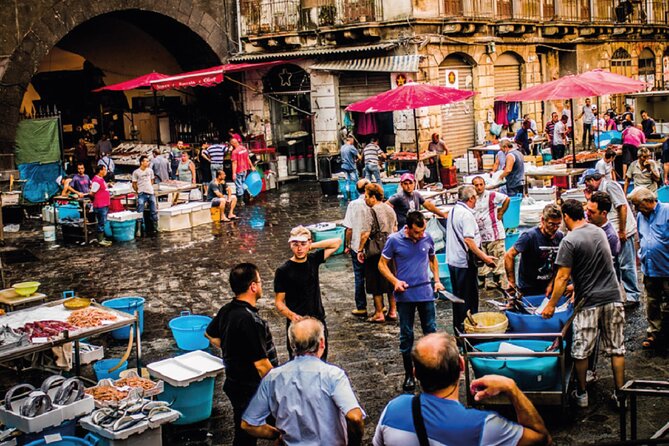
This isn’t the kind of “follow a person and hope you’re not stuck behind someone” tour. It’s a self-guided walking route with an audio guide and matching text, so you control the speed. That matters in Catania, where the streets can be lively, sun can hit hard, and you’ll probably want extra minutes for photos at the Duomo façade or to linger around the market smells and sounds.
The format also makes the guide feel useful, not just descriptive. You don’t only get what something is called—you get the why. For example, you’re not just told where Fontana dell’Amenano is. You also learn it’s dedicated to the underground river that runs beneath the city linked to Etna. That kind of detail changes how you look at a place, even if you’re only there for a short stop.
Finally, at $7.83 per person, you’re buying a lot more than a basic audio download. You get a structured route, multilingual audio/text, and specific tips for local food stops to pair with your sightseeing. In a city where planning around meals can be half the battle, that’s real value.
Price, duration, and walking pace (what to realistically expect)
The tour is priced at $7.83 per person and typically runs 3 to 4 hours. In other words: it’s long enough to feel like you covered the highlights, but short enough that you won’t lose a full day to slow sightseeing.
You’ll notice the time blocks at each stop are mostly 10–25 minutes, except the first and last areas where you get more context time. That’s a smart pacing choice. It gives you enough minutes to read, listen, and look around, without turning the route into a marathon.
One practical note: the experience uses your phone, and headphones aren’t included. You can listen through your phone speakers, but in busy areas that may be tricky. If you already travel with earbuds, bring them. If you don’t, you’ll still be able to do the tour—you just might need to pause your walking more often to hear clearly.
How the audio and written guide is set up on your phone
This is a digital guide by Walking Cap, not an in-person host. You’ll receive details in your voucher about how to activate the guide, and the guide works through your smartphone. The info you need is delivered digitally, and the experience is designed to keep you moving with Google Maps connection.
To get the smoothest experience, do two things before you leave your lodging:
- Confirm you have stable internet for the whole walk (or at least enough to keep the guide functioning).
- Make sure your audio settings are ready so you don’t lose the narration at the worst time—like when you’re facing a façade and want the story.
Also, you can listen through your phone’s speakers or use headphones if you have them. This flexibility is handy in Italy, because sometimes you’ll stand still to photograph and sometimes you’ll just want quick context while walking.
Stop 1: Ursino Castle and why the lava-stone setting matters
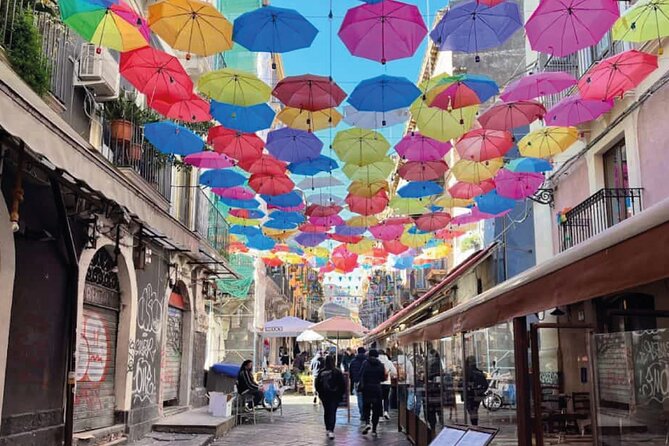
Your route starts at Ursino Castle (P.za Federico di Svevia, 21). The castle sits in a large square named for Frederick II of Swabia, and the story begins with geography: it originally stood much closer to the sea, with defensive structures and a moat concept.
The guide’s description is especially good at pointing out the building materials and layers. You’ll see the external wall built from well-cut and regular lava stone blocks, while the inner wall is more irregular. That contrast helps you read the structure like a timeline—defenses built, rebuilt, and reshaped over time.
Expect about 1 hour here. You’re not going to just pass through. You’ll have time to walk the space at a calm pace, match what you see with the audio prompts, and decide how deep you want to go visually.
A few we would gladly point a friend toward in Catania



Stop 2: A’ Piscaria Mercato del Pesce for real Catania atmosphere
Next comes the A’ Piscaria Mercato del Pesce, Catania’s fish market in the historic center near Piazza del Duomo and the Fontana dell’Amenano. This stop is quick—around 20 minutes—but it’s one of the best ways to break up the grand monuments with everyday life.
This is one of those stops where you’ll probably remember more than the facts. You’re likely to notice how locals talk about it (Piscarìa in Sicilian dialect), and you’ll feel the market’s role as a neighborhood hub rather than a tourist-only sight.
If you want to turn sightseeing into something practical: use this moment to orient yourself for the next phase. You’ll be right near the Duomo area, so your next steps will feel close and logical rather than scattered.
Stop 3: Fontana dell’Amenano and the underground river idea

After the market, head to Fontana dell’Amenano, created in 1867 by sculptor Tito Angelini, using Carrara marble. The key detail isn’t just its age—it’s what it represents. It’s dedicated to the Amenano, the underground river that flows beneath the city, tied to the environment around Etna.
This stop is short (about 10 minutes), but it’s powerful because it reframes the city. Catania isn’t only about what you see on the surface. With the guide’s prompt, you’ll start noticing how the city’s identity relates to what’s happening underground.
Stop 4: Piazza del Duomo—your mental “center of gravity”
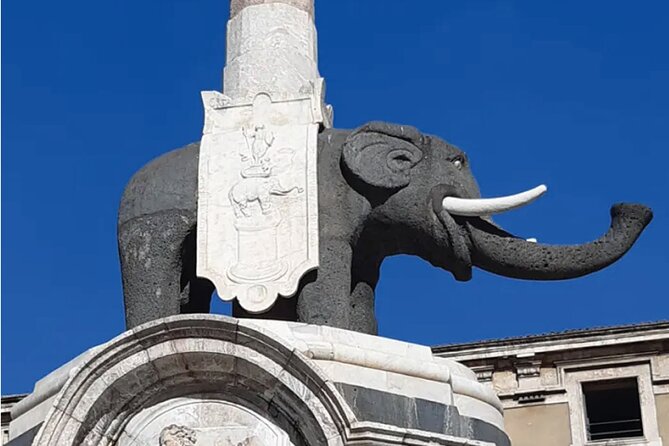
Then you reach Piazza del Duomo, the beating heart of Catania’s historic center. This is the square where the city’s main monuments crowd together, including the Cathedral of Sant’Agata dedicated to Catania’s patron saint.
The time at this stop is about 20 minutes. That’s enough to stand back and take in how the space functions as a stage. The guide helps you link what you’re seeing to the next stop, so you don’t feel like you’re just looking at buildings—you’re building a mental map.
If you like to travel with purpose, this is where you decide what you want to linger on next: cathedral façade, interior time (if you choose to), or the surrounding streets.
Stop 5: Basilica Cattedrale di Sant’Agata (Baroque, rebuilt, still you can read it)

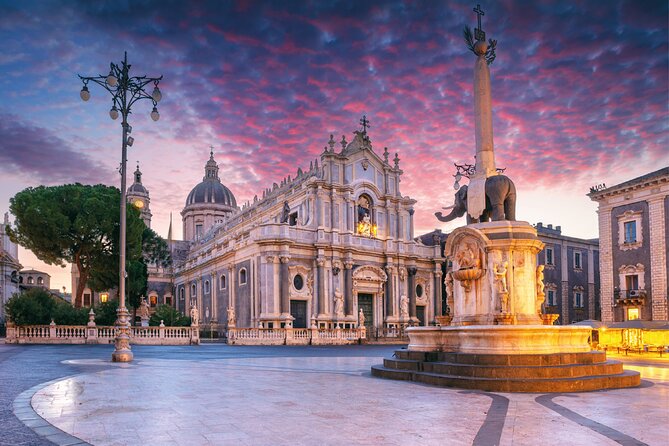
Your next anchor is the Basilica Cattedrale di Sant’Agata. The guide points out it’s a major example of Baroque architecture, originally built in 1090 over the remains of an ancient Roman temple dedicated to Jupiter. Then comes the big turning point: the earthquake of 1693, which destroyed much of the city, followed by rebuilding.
That sequence is crucial. You’re not just admiring style. You’re seeing survival. The cathedral becomes a record of layers—Roman foundations, medieval starting points, and Baroque reconstruction after disaster.
You’ll spend about 20 minutes here, which is enough for a focused look at the outside and for getting oriented for the inside if you choose to go in on your own.
Stop 6: Piazza Università and the bronze lamppost legend game
From the cathedral area, the route shifts to Piazza Università, named after the Palazzo degli Studi. The star feature is unusual: four bronze lampposts placed at the corners, each tied to popular Catania legends.
The guide identifies the characters: Gammazita, the sailor Cola Pesce, the brothers Anfinomo and Anapia, and the paladin Uzeta. It’s the kind of storytelling detail that makes a square feel like it belongs to people, not just architecture.
This stop is short (around 10 minutes), but it’s worth treating like a mini scavenger hunt. Look up at the lampposts while the audio runs. When the story clicks, the square suddenly feels alive.
Stop 7: Anfiteatro Romano beneath Piazza Stesicoro (optional, ticketed)
Next is the Anfiteatro Romano, an ancient Roman theatre dating back to the 1st century BC beneath Piazza Stesicoro. The guide notes it was submerged over time by eruptions of Etna and seismic events.
Important logistics: the guide says you won’t go inside as part of this experience, but you can visit it by yourself if you want. The ticket is not included and costs €4.
You get about 25 minutes allotted here, likely enough time to locate the area, listen to the context, and decide whether that extra ticket is worth it for you. If you love Roman ruins, you may want to spend the extra money. If you’d rather keep your budget and move on, you can still get meaningful value from learning what’s under the square.
Stop 8: Via dei Crociferi—Catania’s film-set street moment
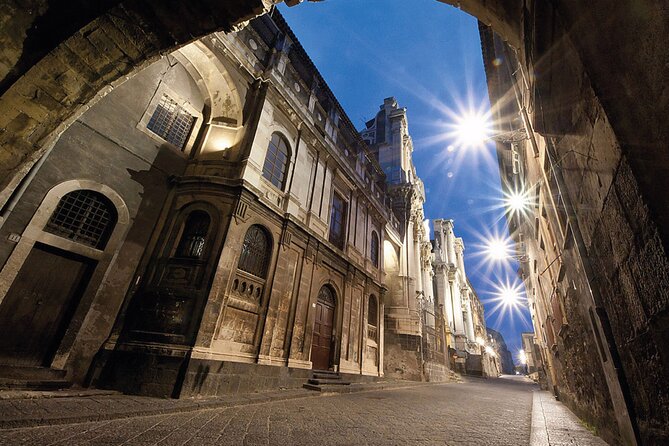
A short walk brings you to Via dei Crociferi, described as one of the oldest and most evocative streets in the historic center. It’s known for cinematic charm—so yes, it’s the kind of street that makes you want to slow down and take photos in the right light.
The time here is about 10 minutes. Don’t treat it like a long stop. Use it for what it’s best at: quick visual satisfaction and a reset between heavier sights.
This is also where the self-guided format shines. You can pause when you see the exact angle you want, then press play again when you’re ready for the next piece of the story.
Stop 9: Benedictine Monastery of San Nicolò l’Arena—your final big cultural pause
The tour ends at the Benedictine Monastery of San Nicolò l’Arena (Piazza Dante Alighieri, 32). This is a strong finish because the guide frames it as a historical reference point, especially in the 18th century for its grandeur and richness of rooms, plus the noble origins of the monks.
You’ll spend about 30 minutes here. That makes a nice landing after the walking and city noise. Even if you don’t go deep into every room, the route’s emotional rhythm works: from market energy to grand squares to monastery quiet.
Because the tour is digital, you’re not locked into a tight end-of-tour script. The experience listing notes you can choose your ending point, which is helpful if you want to keep exploring nearby streets after the guide stops.
What I’d do to get the most value from this route
If you want this to feel like a great use of your time (and not just a checklist), I’d plan your day like this:
- Start early enough that you can enjoy Ursino Castle without rushing.
- Keep earbuds or a small headset ready, since headphones aren’t included and the market area can get loud.
- Treat the Duomo + Sant’Agata blocks as your “must linger” portion. Everything else is good context, but those are the heavy hitters.
- If you’re tempted by the Roman Theatre, decide based on your energy at that moment. The €4 ticket is optional, and you’ll still understand the site even if you skip it.
Also, the guide includes best advice for local restaurants with authentic food. Even if you don’t follow every suggestion blindly, use it as a starting point for where to eat after your walk.
Who this works best for (and who might want something else)
This is a smart match for you if:
- You like self-paced sightseeing and the freedom to pause for photos or detours.
- You’re comfortable using a smartphone for navigation and audio.
- You want a low-cost way to hit core Catania highlights with real context.
It may be less ideal if:
- You’re traveling with poor phone reception or battery anxiety.
- You really want an in-person guide answering questions on the spot.
- You strongly prefer a central starting point. One practical note from real-world experience: people sometimes have to walk to the start and then retrace if their lodging is far off your starting square.
Should you book this Catania audio walking tour?
If you want a cost-effective way to see Catania’s top landmarks in a logical order, this is an easy yes. At $7.83, you get a structured route, multilingual audio/text guidance, and Google Maps support—plus food tips. The stop-and-go format is also a big win because you can linger where you care most.
I’d book it if you’re the type who enjoys learning while looking, and you’re fine listening on your phone. Just don’t show up without checking your guide activation steps in your voucher, and bring a way to hear the audio clearly (headphones if possible).
If you tell me your travel dates and where you’ll be staying, I can suggest the best way to approach the start at Ursino Castle and the most comfortable order for your day.
FAQ
What language options are available?
The audio-guide and text are available in English, Spanish, Italian, German, and French.
Is this a live in-person guide?
No. This visit uses a digital audio and written guide on your phone. There is no in-person guide during the walk.
Do I need headphones?
Headphones are not included. You can use your smartphone speakers or headphones if you have them.
How long is the walking tour?
It usually takes about 3 to 4 hours.
Are tickets included for the Roman Theatre?
No. The Anfiteatro Romano ticket costs €4 and is not included.
Where does the tour start and end?
It starts at Ursino Castle (P.za Federico di Svevia, 21, Catania) and ends at the Benedictine Monastery of San Nicolò l’Arena (Piazza Dante Alighieri, 32, Catania).
Do I need a smartphone and internet connection?
Yes. You need a smartphone with an internet connection to use the digital guide.
What’s the cancellation and refund window?
You can cancel for a full refund up to 24 hours in advance of the experience’s start time. If you cancel less than 24 hours before, it won’t be refunded.
How big is the group?
The experience has a maximum of 104 travelers.
More Tours in Catania




More Tour Reviews in Catania


Keep Exploring Catania
Just added: the newest Catania tours in our notebook
- Transfer Catania / Agrigento Airport★ 5.0 · 3 reviews
- Sicily private shore excursion – Etna and Taormina with personal driver★ 3.5 · 3 reviews
- Sunset Trekking on Mount Etna★ 5.0 · 3 reviews
- Private Transfer from Catania to Palermo or vice-versa with stop★ 5.0 · 3 reviews
- From Syracuse: Mount Etna Volcano Morning Trekking Tour★ 5.0 · 3 reviews
- Catania: Guided Street Food Tour with Tastings★ 5.0 · 3 reviews
Catania Tours, compared.
 ★ 4.8Catania: Mount Etna Morning or Sunset Day Trip with TastingFrom $704,028 reviews
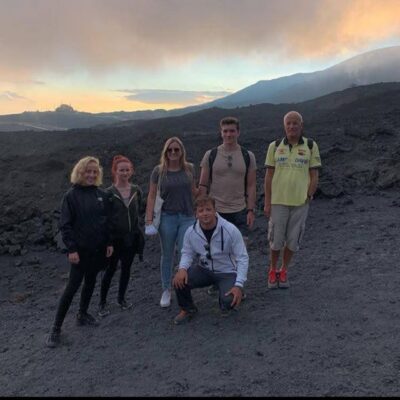 ★ 4.8Catania: Sunset Jeep Tour of Mount Etna and Lava Flow CavesFrom $712,113 reviews
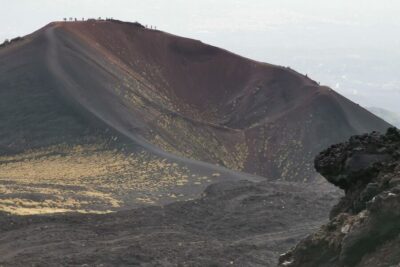 ★ 4.9Catania: Mount Etna Trekking Tour Beyond the Tourist TrailsFrom $811,596 reviews
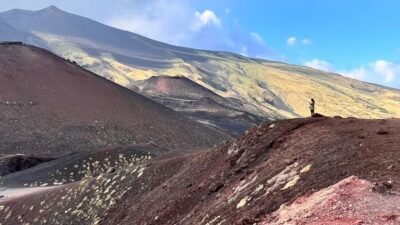 ★ 4.8Catania: Etna Sunset Tour with Pickup and Drop-offFrom $711,348 reviews
 ★ 4.8Etna Sunset Tour: Volcano trek, Cave & tasting from CataniaFrom $701,290 reviews
 ★ 4.8Catania: Etna Morning Excursion with Tasting and PickupFrom $711,224 reviews
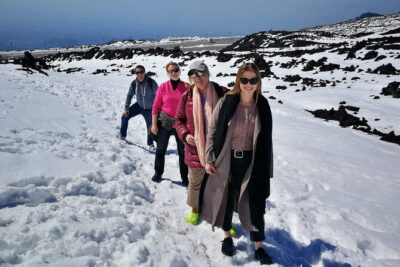 ★ 5.0Mt. Etna and Taormina village full day tour from CataniaFrom $1181,155 reviews
 ★ 4.9Catania: Amazing Etna Morning Tour with Pickup and Drop-OffFrom $81799 reviews
Browse the lists this tour appears in