
Reviewed · TAORMINA TOURS
Taormina: Dining Experience at a Local’s Home
Sicilian home dinners can be magic. In Taormina, this private Cesarina evening mixes a show cooking demo with family recipes passed down by mammas, then serves everything as a 4-course meal. You also get the feel of real Italian hospitality, not a staged tourist show.
The one thing to watch is consistency: some people report that the cooking felt limited and food was prepared ahead, and a few felt the setting wasn’t the private home they expected. If that part matters to you, plan a couple quick questions before you book.
In This Review
- Quick hits: what makes this Taormina dinner worth your time
- A Taormina home dinner built around mammas, not choreography
- The 4-course Sicilian meal: what you’ll eat, and why it matters
- Drinks: wine you can actually pair with food
- The cooking demo: what you should expect to see
- Practical tip before you go
- Meeting in a home: privacy, the address, and what to plan for
- Timing options
- Language and pacing: how to make it work even if English is limited
- Who’s this dinner best for in Taormina?
- You’ll probably love it if you:
- You might feel uneasy if you:
- Price and value: when it feels fair and when it stings
- My recommendation for value-focused bookings
- Tips to get the most out of your Taormina evening
- Should you book this Taormina local home dinner?
Quick hits: what makes this Taormina dinner worth your time
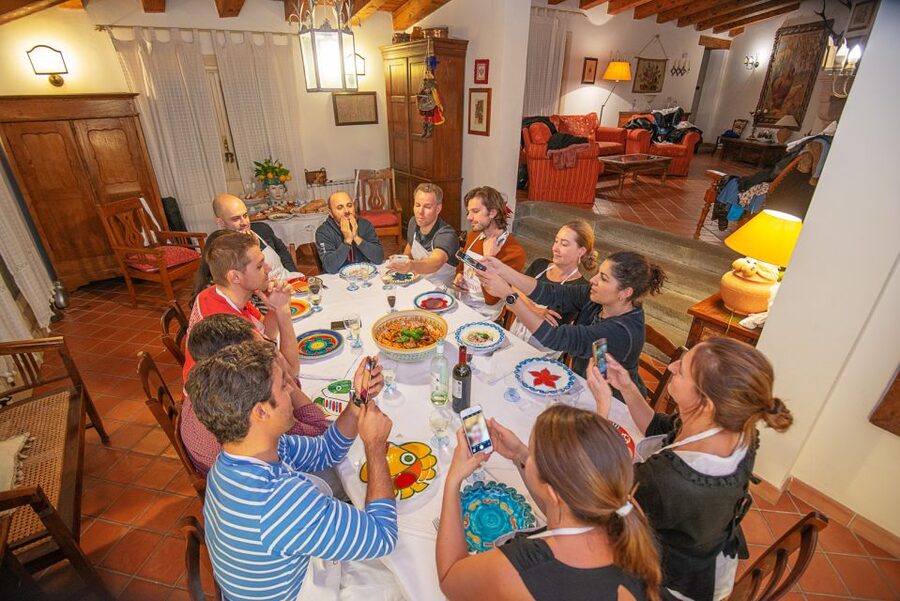
- Cesarina-style format: a local host at home, focused on family cookbook recipes and hands-on stories
- 4-course Sicilian menu: starter, pasta, main with a side, then dessert
- Drinks included: water, red and white wine from regional cellars, plus coffee
- Language support: the instructor works in English and Italian
- Souvenir apron: an official apron to take home
- Private group, but not always totally just your table (some evenings include the host’s household circle)
Still wandering Taormina? Keep going
- Taormina: Ancient Theater Skip-the-Line Ticket & Audio Guide
★ 4.5 · 2,412 reviews - Seaview Cooking Class & Taormina local flavors with Chef Mimmo
★ 5.0 · 665 reviews - Taormina: Opera Performance in the Nazarena Theater
★ 4.7 · 651 reviews - Taormina: Boat Tour with Aperitif on Isola Bella
★ 4.2 · 647 reviews
A Taormina home dinner built around mammas, not choreography

This experience is sold as a private dining night in a local home. The core promise is simple: you’ll join a Cesarina (a local home-cook host) for a cooking demo and tasting of authentic Sicilian recipes that families have kept in their own cookbooks for generations.
What I like most is that the “value” isn’t only in the food. It’s also in the context. Sicilian cooking has regional personality—ingredients, seasonings, and techniques shaped by the island. When the host frames a recipe as something she learned at the family table, it changes how you taste it. You’re not just eating pasta; you’re picking up the why behind it.
The format is also built for relaxed conversation. It’s not a fast ticket line or a production where you’re herded from course to course. In many similar experiences, the meal feels like it belongs to the home. Here, that’s the point.
That said, one practical thing: “private home” experiences can vary from night to night depending on the host’s setup. A couple of reports said it looked more like a restaurant meal, and others said the cooking portion felt minimal because most food was prepped earlier. That doesn’t mean every night is the same, but it does mean you should match your expectations to what’s really included: a demo plus tasting, followed by a full 4-course meal.
The 4-course Sicilian meal: what you’ll eat, and why it matters
You’re scheduled for a 4-course dinner in a traditional flow:
1) Starter
2) Pasta course
3) Main course with a side dish
4) Dessert
That lineup matters because it mirrors how Sicilian home meals build rhythm. Starters set the table—often with seasonal flavors or island staples. Then pasta carries the “center of gravity” of the meal, where technique and sauce matter most. The main course plus side gives you the heft, then dessert brings things back to something sweet and familiar enough to remember.
One reason this matters for value: pasta and dessert alone can be a full evening in many parts of Italy, but here you get four structured courses. And drinks are included with it—water, wine, and coffee—so you’re not doing the mental math mid-dinner.
Drinks: wine you can actually pair with food
You get:
- water
- a selection of red and white wines from regional cellars
- coffee at the end
I think this is a big deal for a home-host experience. Wine isn’t always guaranteed on these formats, and when it is, quality can vary. Here, it’s specifically described as coming from regional cellars, which usually means you’ll taste something designed for local food—not generic house wine.
Just keep in mind: a few people reported missing elements they expected (like coffee or wine). That seems like a timing or service hiccup more than a consistent rule, but it’s worth asking about if those items matter to your plan.
The cooking demo: what you should expect to see
This experience is marketed as an exclusive show cooking demo. In other words, you should be seeing real preparation and learning, not only tasting.
In practice, the experience can land on two different ends of the scale:
- Best-case nights: you watch the host prepare dishes and you get clear explanations that connect the food to family habits and Sicilian flavors.
- More “seated dining” nights: some of the food may be prepared ahead, and what you see during the demo could be shorter than you expect.
A few specific examples from real experiences:
- One dinner included only a small display (like brief prep tasks) while much of the meal seemed ready beforehand.
- Another report said the cook left during the meal due to a family situation, which reduced time spent in the kitchen with the group.
I don’t want you to panic—this is still a dining experience—but if you’re booking specifically to learn technique, you’ll want to clarify what “demo” means for your dinner time.
A few we would gladly point a friend toward in Taormina

Practical tip before you go
When you message the organizer (before arrival), ask one direct question:
- How much of the cooking happens in front of you during the 3 hours?
It’s a simple question. You’ll avoid disappointment if your dinner is more tasting-heavy than cooking-heavy.
Meeting in a home: privacy, the address, and what to plan for
This is one of the parts that’s both romantic and logistical.
Because it’s a private home, you won’t get the full address upfront. For privacy, the host address is shared after booking, and you’re typically contacted by customer care via email with the exact meeting point details plus a mobile number.
That matters for you because:
- You’ll want to check email carefully after booking.
- Don’t plan a late arrival or you may have trouble finding the place quickly.
Also, remember the local-home rhythm. You’re not walking into a lobby. You’re stepping into someone’s living space. You’ll likely need to be ready for shoes, coats, or entry routines that are normal for a home but not for a restaurant. Keep your expectations flexible.
Timing options
Typical start times are:
- 12:00PM
- 7:00PM
The experience notes that times are flexible with advance request. If you’re picky about cooking time (for example, wanting a more active kitchen period), choose the time that best fits the host’s schedule and the amount of preparation that tends to happen early.
Language and pacing: how to make it work even if English is limited
The instructor is listed as English and Italian, which is what you’d hope for. But one report described a chef who didn’t speak English well, with a young Japanese friend acting as interpreter.
So here’s the practical reality: language may vary by host and evening. That doesn’t automatically ruin the meal—it can still be warm, clear, and delicious—but it can affect how much explanation you get.
To make it smoother:
- Bring curiosity more than perfection.
- If you’re serious about learning, come with two or three questions in your pocket, like what makes this Sicilian recipe different or what ingredient gives the dish its character.
Pacing matters too. One report said the host stepped away for an emergency and the group finished dinner with other household members. That’s not something you can predict, but it’s a reminder: this is a home, not a hotel kitchen. If you want a very strict, no-surprises schedule, you may prefer a more standardized class.
Who’s this dinner best for in Taormina?
This experience fits best when you want food plus people, not just food.
You’ll probably love it if you:
- enjoy slow meals and conversation
- want Sicilian flavors explained through family habits
- like private settings where you can ask questions
- are comfortable with the idea that a home kitchen has its own flow
You might feel uneasy if you:
- booked only for hands-on cooking, and expect you’ll be actively cooking the whole time
- want maximum English instruction without any chance of interpretation
- dislike the possibility that a home host may step away briefly for personal matters
Also, while it’s a private group, one dinner included the host’s household circle (people staying with the host who attended Italian school). That suggests “private” may mean private arrangement, not necessarily an empty house. If you prefer a strictly silent, only-you table, ask how many people typically join the meal in addition to your group.
Price and value: when it feels fair and when it stings
The real value question here is what you’re paying for:
- a 3-hour experience
- a 4-course menu
- drinks (wine, water, coffee)
- a cooking demo plus recipe context
- a souvenir apron
That’s a solid bundle on paper. In the positive end of the experiences, people described incredible food and a warm family atmosphere, including the feeling that the meal led naturally into more local dining. One mention highlighted a host named Donatella Rapisardi and her mom as fantastic guides and hosts.
But on the negative end, a couple of people felt the price didn’t match what happened in the kitchen. The biggest complaint wasn’t that the food tasted bad—it was that the demo was limited, the food seemed prepared ahead, and one evening lacked items described as included (like wine, coffee, and the apron).
So here’s the balanced way to think about value:
- If the demo is active, explanations are clear, and the meal feels fully like a host-led home dinner, this can feel like a memorable splurge.
- If your dinner is mostly a plated meal with minimal cooking in front of you, it can feel expensive compared with other Sicilian food experiences.
My recommendation for value-focused bookings
Before you commit, confirm three things in one message:
- demo time: how much cooking happens during the 3 hours
- what’s included at the end: wine/coffee and the official apron
- setting: that it’s hosted in a local home (not a restaurant)
These questions take minutes and can save hours of disappointment.
Tips to get the most out of your Taormina evening
If you want this to land as a meaningful cultural meal, do these small moves:
- Ask what the recipe’s family connection is. Even one short story makes the flavors stick.
- Taste the wine with the food, not at the end. You’ll understand the pairing better.
- Go with a flexible mindset about the kitchen. This is a home setup, so some prep may be done earlier.
- Plan for a warm but casual pace. Home dinners aren’t staged timelines.
And if you’re the type who needs clarity, be the kind customer who asks. The best outcomes often come from simple, direct questions.
Should you book this Taormina local home dinner?
I’d book it if your top goal is a warm, local-host Sicilian meal—especially if you’re excited by the idea of family recipes and a cooking demo that comes with context.
I’d be cautious if your priority is guaranteed, in-depth cooking instruction with lots of visible hands-on prep. Based on what can happen on some nights, the demo portion may not always be as active as you expect, and occasionally the dinner setup may feel closer to a restaurant meal than a true at-home cooking moment.
If you book, do it smart:
- choose your time carefully (midday vs evening can change the flow)
- ask how much cooking you’ll see
- confirm the included items you care about most
When it clicks, it’s exactly the kind of Taormina experience that makes you feel like you sat down with Sicily, not just beside it.
More Dining Experiences in Taormina

More Tour Reviews in Taormina






Taormina, a Few More Ways In
Just added: the newest Taormina tours in our notebook
- Godfather Tour from Messina cruise terminal to Savoca and Forza D’Agrò★ 3.5 · 3 reviews
- Taormina Sunset tour in search of dolphins with aperitif★ 3.5 · 3 reviews
- Boat tour:isola bella taormina★ 4.7 · 3 reviews
- Taormina: BOAT PARTY IN CATAMARANO NELLA BAIA DI TAORMINA★ 5.0 · 3 reviews
- Sea, Volcano and History: Giardini Naxos, Isolabella, Etna and Taormina★ 4.5 · 3 reviews
- Private One Day Tour to Taormina and Mount Etna★ 5.0 · 3 reviews
Taormina Tours, compared.
 ★ 4.5Taormina: Ancient Theater Skip-the-Line Ticket & Audio GuideFrom $282,412 reviews
 ★ 5.0Mt. Etna and Taormina village full day tour from CataniaFrom $1181,155 reviews
 ★ 5.0Seaview Cooking Class & Taormina local flavors with Chef MimmoFrom $157665 reviews
 ★ 4.7Taormina: Opera Performance in the Nazarena TheaterFrom $35651 reviews
 ★ 4.2Taormina: Boat Tour with Aperitif on Isola Bella647 reviews
 ★ 5.0Taormina and Castelmola Tour from MessinaFrom $114645 reviews
 ★ 4.8From Catania: Full-Day Mount Etna and Taormina Tour644 reviews
 ★ 5.0Mount Etna Half-Day Small Group Tour from TaorminaFrom $105628 reviews
Browse the lists this tour appears in